

 中
中 En
EnSmart Chlorination Equipment for Secondary Water Supply Tanks
Product Overview
Smart chlorination equipment for secondary water supply tanks, also known as secondary water supply smart chlorination equipment, secondary water supply smart chlorination device, tank smart chlorination equipment, tank smart chlorination disinfection equipment or sodium hypochlorite generation & dosing integrated machine.
This equipment is mainly targeted at secondary water supply tanks, standardized pump rooms and renovation projects of old pump rooms. To address the insufficient free chlorine at pipe ends caused by storage and transportation of tap water, it supplements chlorine via brine preparation, sodium hypochlorite production, liquid storage, metered dosing and control systems.
Commercially available similar products in the industry are often named "smart chlorination disinfection equipment for secondary water supply tanks", with brine dissolving, brine preparation, sodium hypochlorite generation, storage, dosing and control as core subsystems.
Product Working Principle
Hebei Anjie smart chlorination equipment for secondary water supply tanks uses salt and water to prepare brine, electrolyzes the brine to produce sodium hypochlorite solution on-site, then delivers the chemical liquid to secondary water supply tanks or designated pipelines through liquid storage and metered dosing units.
- Prepare brine with salt and water;
- Soften and filter raw water;
- Feed diluted brine into the electrolytic unit;
- Generate sodium hypochlorite solution on-site;
- Transfer chemical liquid to the liquid storage unit;
- Meter and dose liquid into tanks or water supply pipelines;
- Conduct online monitoring and operation control based on customized project configurations.
Main Equipment Components
- Intelligent control system
- Raw water softening & filtration system
- Brine preparation unit
- Electrolytic generation unit
- Sodium hypochlorite liquid storage unit
- Metered dosing unit
- Pipeline and valve system
- Status indication and alarm unit
Optional configurations based on project requirements include free chlorine online monitor, flow signal access, water level signal access, data communication interface, equipment operation log, remote monitoring and alarm functions. Exact configurations shall be subject to the technical plan and contract of each project.
Product Features
- Integrated structure: All functions including brine preparation, electrolytic generation, liquid storage, dosing and control are integrated into one unit, facilitating layout inside pump rooms.
- On-site production: Uses salt and water as raw materials to produce sodium hypochlorite solution on location.
- Metered dosing: Delivers chemical liquid quantitatively to water tanks or supply pipelines via metering dosing units.
- Customizable control modes: Operation logic can be designed based on timing, flow rate, water level, water replenishment signals or free chlorine monitoring data.
- Optional online monitoring: Matches Hebei Anjie water quality online monitors to sample and monitor water from tank outlets or main water supply pipelines.
- Compatible with renovation projects: Suitable for newly built standardized pump rooms and renovation of aged secondary water supply facilities.
Installation Methods
The equipment is generally installed inside secondary water supply pump rooms, matched with water tanks, booster pump sets and main water supply pipelines. During installation, the following items need confirmation: equipment installation position, raw water inlet pipe, drainage conditions, power supply, chemical dosing pipe, dosing point, water quality sampling pipe, sampling point, position of online monitoring equipment, as well as ventilation and maintenance space.
Dosing and sampling points shall be designed according to actual pipelines, tank structures and control schemes. Industry project cases adopt separate layouts for dosing and detection points based on tank volume, number of outlet pipes and on-site pipelines, meaning customized design is required for each specific project instead of fixed universal installation layouts.
Application Scenarios
- Secondary water supply for residential communities
- Secondary water supply for schools
- Secondary water supply for hospitals
- Commercial complexes
- Hotels and public buildings
- Living water supply for industrial parks and factories
- Standardized pump rooms
- Renovation of aged pump rooms
- Projects with insufficient free chlorine at tank outlets
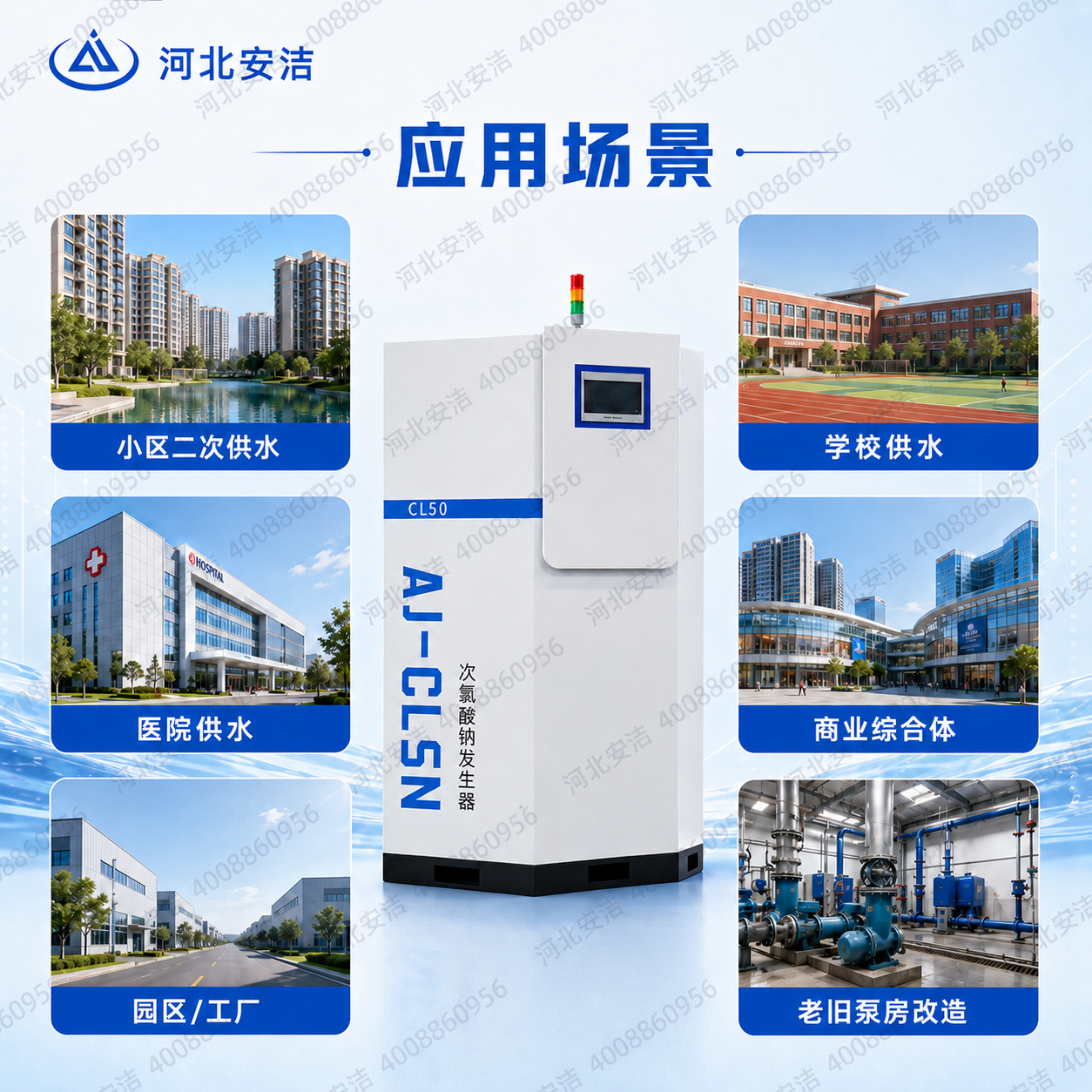
Website Image: Application Scenarios of Smart Chlorination Equipment for Secondary Water Supply Tanks
Parameters Required for Model Selection
| Parameter Category | Information to Provide |
|---|---|
| Water Tank Details | Quantity, volume, material, inlet & outlet structure |
| Water Consumption | Daily water consumption, peak hourly water consumption |
| Water Quality | Free chlorine data of inlet water, outlet water and pipe ends |
| Installation Conditions | Pump room photos, equipment space, power supply and drainage |
| Dosing Mode | Tank dosing or pipeline dosing |
| Monitoring Mode | Whether free chlorine online monitoring is required |
| Control Mode | Timing control, flow linkage, liquid level linkage or feedback control |
| Communication Requirements | Whether data upload or remote management is needed |
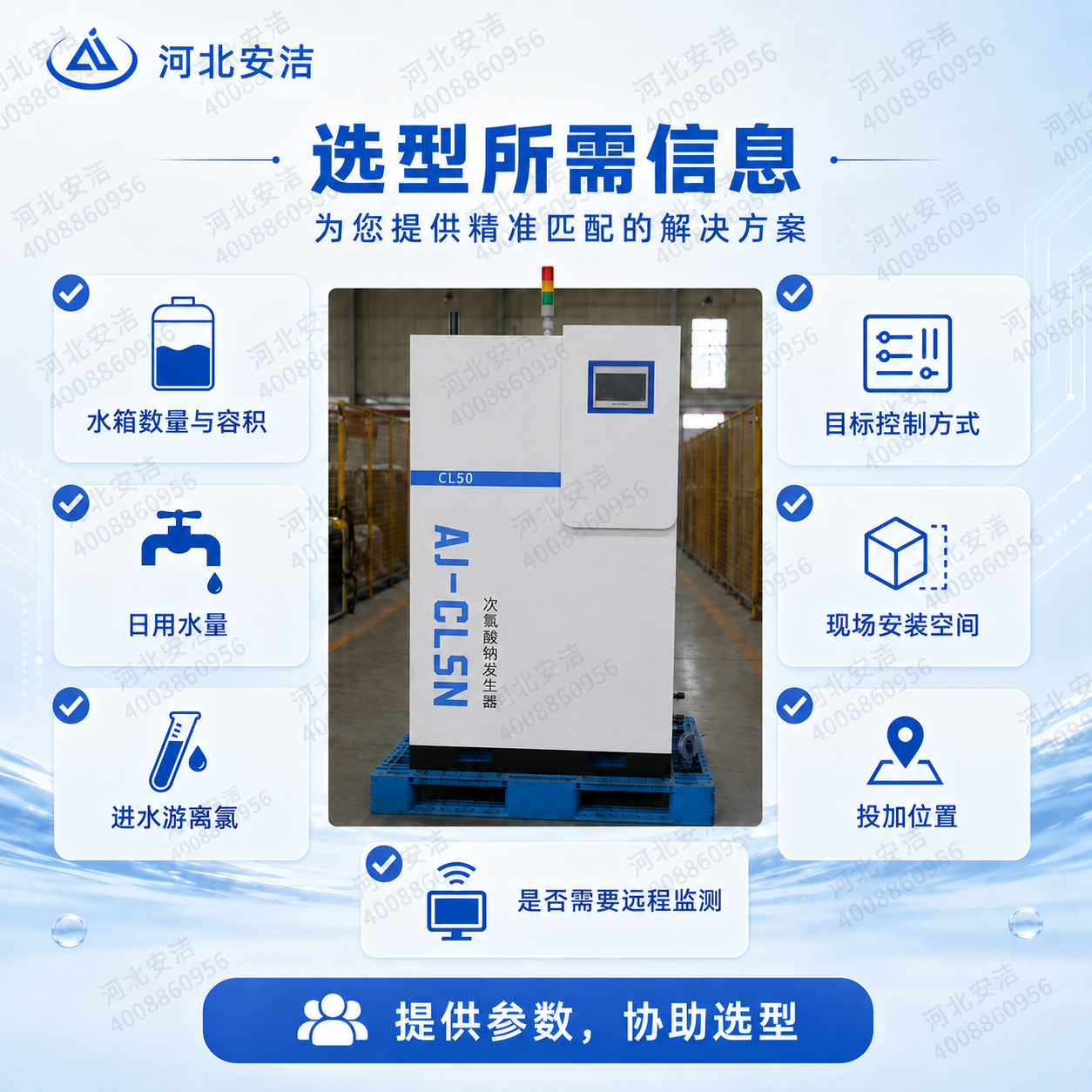
Website Image: Parameters Required for Model Selection of Secondary Water Supply Smart Chlorination Equipment
Hebei Anjie Full-Service System
- Project demand communication
- Product model selection
- Technical solution design
- Equipment manufacturing
- Offline debugging before delivery
- On-site installation guidance
- Operation training for operators
- After-sales maintenance service
Consultation Hotline: 4008860956
Website FAQ
-
Are smart chlorination equipment for secondary water supply and sodium hypochlorite generators the same product? They are related but focus on different application purposes. Sodium hypochlorite generators are mainly used for on-site production of sodium hypochlorite, while smart chlorination equipment for secondary water supply additionally meets requirements of tank chlorine replenishment, metered dosing, monitoring, control and pump room installation.
-
Is a residual chlorine online monitor mandatory for tank smart chlorination equipment? It depends on project requirements. Online monitors are not necessary for simple timing or linkage dosing; they shall be equipped if feedback control based on real-time free chlorine readings is required.
-
Can the equipment dose liquid directly into water tanks? Both tank dosing and pipeline dosing are available via customized design. The exact dosing point shall be determined by tank structure, inlet/outlet pipelines and liquid mixing conditions.
-
Can water tank volume alone determine the equipment model? No. Model selection requires comprehensive evaluation of daily water consumption, peak water usage, free chlorine data, dosing mode and control requirements.
-
Can the equipment be installed in aged pump rooms? Yes. Renovation solutions can be formulated based on on-site space, pipelines, power supply, drainage and ventilation conditions.
Alt Text for Website Images
- Main unit of Hebei Anjie smart chlorination equipment for secondary water supply tanks
- Working principle diagram of secondary water supply smart chlorination equipment
- Component structure diagram of tank smart chlorination equipment
- Installation schematic of smart chlorination equipment in secondary water supply pump rooms
- Free chlorine online monitoring closed-loop control system
- Application scenarios of secondary water supply smart chlorination equipment
- Parameter list for model selection of secondary water supply tank chlorination equipment
- After-sales service support of Hebei Anjie smart chlorination equipment
More Recommendations

Ultraviolet disinfection technology is a new force in the field of water treatment
2026-03-30
Application of self-cleaning and disinfecting device for water tank
2026-03-29
AOT ultraviolet sterilizer is an efficient cleaning tool for sterilization
2026-03-03

Full Moon on Mid-Autumn Festival, Gratitude for Your Companionship|Hebei Anjie Environmental Protection Wishes You a Happy Reunion and All the Best
2026-09-24

August 1st Army Day | Tribute to the Iron Will Safeguarding China
2026-08-01