
 中
中 En
EnWith the continuous development of urbanization and industrialization, the shortage of water resources and water pollution problems have become increasingly prominent. To solve these problems, people need to adopt more efficient and environmentally friendly water treatment technologies. AOT photocatalytic sterilizer is an advanced device that meets this demand. This article will introduce the relevant information of AOT photocatalytic sterilizer from its principles, characteristics, application fields, and other aspects.
1、 Principle
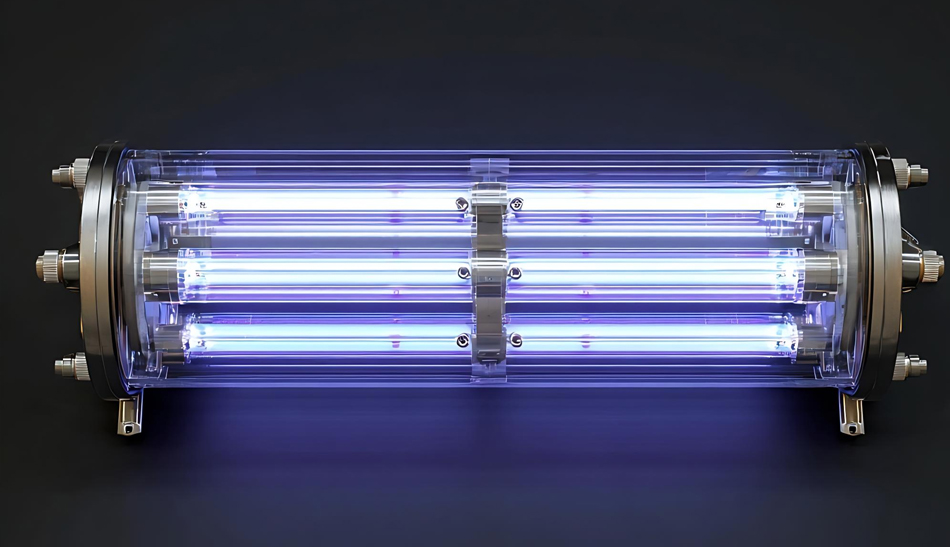
The AOT photocatalytic sterilizer utilizes AOT photocatalysts to generate oxidants (such as hydroxyl radicals) under ultraviolet radiation, helping to decompose harmful substances such as organic matter, bacteria, and viruses in water. AOT is an abbreviation for hexadecyltrimethylammonium bromide, which is a surfactant with excellent photocatalytic performance. When AOT is exposed to ultraviolet light, it excites electrons and forms pores, thereby accelerating the redox reaction in water. Meanwhile, the surface activity of AOT photocatalysts can effectively adsorb and decompose organic substances in water, thereby achieving the goal of purifying water quality.
2、 Characteristics
Efficient disinfection: AOT photocatalytic sterilizer can effectively kill bacteria and viruses in water, and its disinfection effect is more efficient than traditional chemical disinfection methods.
Environmental protection and energy conservation: AOT photocatalytic sterilizers do not require the use of chemical disinfectants, avoiding harmful substances from polluting the environment while also saving energy and costs.
Safe and reliable: AOT photocatalytic sterilizer kills bacteria and viruses through ultraviolet radiation, without producing any chemical residues, and is harmless to the human body. At the same time, the device adopts an intelligent control system that can automatically monitor the operating status and make corresponding adjustments.
Widely applicable: AOT photocatalytic disinfectors are suitable for various types of water treatment facilities, such as waterworks, sewage treatment plants, swimming pools, etc. They can effectively purify water quality and reduce the content of harmful substances in water.
3、 Application Fields
Tap water treatment: AOT photocatalytic sterilizer can be used in the water treatment process of water plants to eliminate pollutants such as odor, color, and organic matter in water, and improve the safety and cleanliness of water quality.
Wastewater treatment: AOT photocatalytic disinfectors can be used in wastewater treatment plants to degrade harmful substances in wastewater to meet discharge standards, and can also be used to treat industrial wastewater to meet environmental requirements.
Swimming pool water purification: AOT photocatalytic sterilizer can be used for purifying swimming pool water, eliminating odors and color in the water, killing bacteria and viruses, and improving the health and safety of swimmers.
Agricultural irrigation: AOT photocatalytic sterilizer can be used in agricultural irrigation systems to eliminate harmful substances in irrigation water
4、 Advantages and disadvantages
Compared to traditional disinfection methods, AOT photocatalytic disinfectors have many advantages, such as high efficiency, environmental friendliness, safety and reliability. Meanwhile, the device also has some shortcomings, such as high cost and the need for regular replacement of photocatalysts.
However, with the development of technology and the expansion of production scale, these problems will gradually be solved. In the future, AOT photocatalytic disinfectors will be applied in a wider range of water treatment fields, helping people achieve more efficient and environmentally friendly water resource utilization.
V. Conclusion
In summary, AOT photocatalytic sterilizer is an efficient water treatment equipment that uses the principle of AOT photocatalyst to decompose harmful substances in water under ultraviolet radiation. It can effectively kill bacteria and viruses in water, and also has the advantages of environmental protection, safety and reliability. It is widely used in water treatment plants, sewage treatment plants, swimming pools and other places. Although there are still some shortcomings in this device, with the continuous advancement of technology, it is believed that it will become one of the important tools for future water resource utilization.